
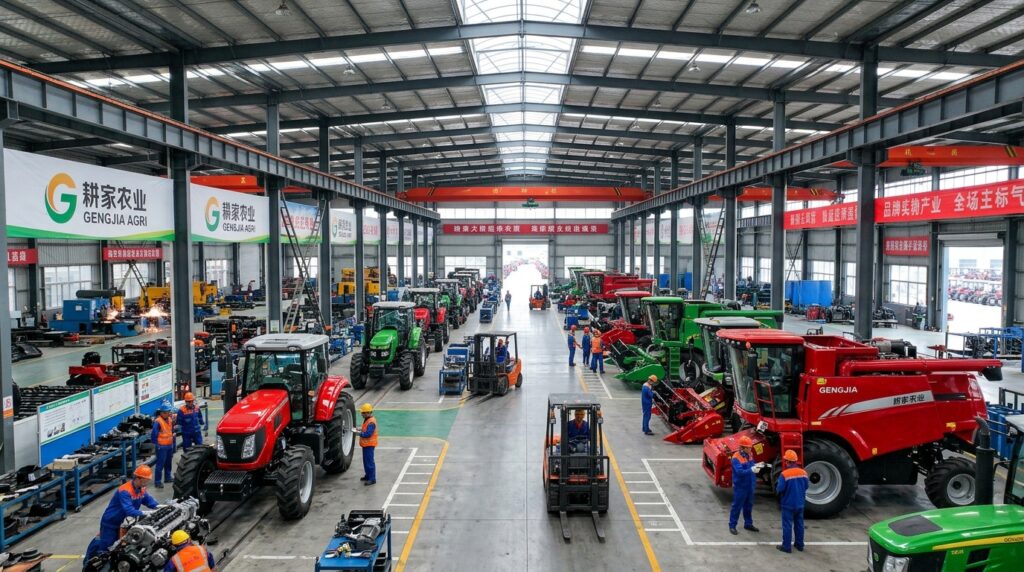

Agriculture is changing rapidly as farmers around the world look for better ways to increase productivity, manage labor costs, and improve the efficiency of everyday field operations. Traditional farming methods remain important, but modern agricultural machinery has made many tasks faster, more consistent, and easier to manage. From preparing the soil and planting seeds to protecting crops and harvesting mature produce, the right equipment can make a significant difference throughout the farming season. Choosing dependable machinery is therefore an important investment for both small farms and large agricultural businesses.
Gengjia Agri is a China-based agricultural machinery manufacturer and global equipment solution provider specializing in tractors, combine harvesters, seeders, sprayers, agricultural drones, and other farming equipment. The company supplies machinery for different agricultural applications and supports customers with equipment selection, customization, spare parts, and after-sales services. With customers in more than 60 countries, Gengjia Agri focuses on providing practical agricultural solutions for different farming environments and market requirements.
Modern agriculture requires more than a single machine. Farmers often need several types of equipment that work together throughout the production cycle. A suitable tractor can power different implements, a reliable seeder can improve planting consistency, and an efficient harvester can help complete seasonal operations on time. Sprayers and agricultural drones also support crop protection and field management.
By bringing multiple equipment categories together, Gengjia Agri aims to help farmers, agricultural businesses, importers, and machinery distributors find suitable solutions for their operational requirements.
Understanding the Importance of Modern Agricultural Machinery
Agricultural machinery plays an essential role in improving the way farms operate. As farming operations become more demanding, relying entirely on manual labor can create challenges involving time, workforce availability, and operational costs. Equipment designed for specific agricultural tasks helps farmers complete important activities more efficiently while maintaining greater consistency.
For example, preparing a large field manually requires considerable time and physical effort. A properly selected tractor with compatible implements can handle soil preparation, transportation, mowing, and other operations more efficiently. Similarly, mechanical seeders help farmers maintain consistent planting depth and spacing, while modern harvesting equipment combines several operations into one working process.
The benefits of agricultural machinery extend beyond saving time. Appropriate equipment can help reduce unnecessary input waste, improve operational planning, and make it easier to manage larger areas of farmland. However, choosing machinery based on actual farm conditions remains essential. A machine that performs well on a large, open field may not be the best choice for a small orchard or greenhouse.
Gengjia Agri provides different agricultural equipment categories to address these varying requirements. Its product range includes machinery for planting, harvesting, spraying, transportation, and other agricultural activities. This broad selection can help customers plan equipment purchases around their crops, field conditions, available labor, and long-term business objectives.
Agricultural Tractors for Different Farming Requirements
Tractors are among the most important machines used in modern agriculture. They provide the power required to operate implements, prepare fields, transport materials, and complete a wide range of everyday farming activities. Because farms differ in size and working conditions, selecting the correct tractor configuration is essential.
Gengjia Agri tractors are available in different horsepower categories, ranging from compact models to heavy-duty machines. The company’s published product range covers approximately 25 HP to 300 HP, providing options for different agricultural applications.
Smaller tractors are useful for orchards, greenhouses, gardens, and relatively narrow working spaces. Medium-horsepower models can support general field operations, transportation, and common tractor-mounted implements. Larger tractors are better suited to demanding workloads that require greater pulling power and hydraulic capacity.
Choosing the Right Tractor Horsepower
Horsepower is an important factor when comparing tractors, but it should not be the only consideration. Farmers also need to evaluate the size of their implements, soil conditions, working hours, terrain, and the type of agricultural activities they perform.
A compact tractor may be sufficient for maintaining a small orchard or working between greenhouse rows. A medium-sized farm may require a stronger machine for plowing, planting, and transporting agricultural materials. Large commercial farms often benefit from higher-horsepower tractors capable of handling demanding implements over extended working periods.
Gengjia Agri offers several tractor configurations with different engine options, transmissions, tires, cabins, and hydraulic arrangements. The company also supports OEM and ODM customization for customers who need equipment adapted to their markets or specific applications.
Tractor Features That Matter in Daily Operations
When purchasing a tractor, buyers should consider more than its engine power. Transmission performance, chassis strength, hydraulic systems, power take-off capabilities, and operator comfort all influence the machine’s practical usefulness.
A dependable transmission helps deliver power smoothly under different working conditions. Hydraulic systems support compatible implements, while PTO connections allow tractors to operate equipment such as mowers, rotary tillers, and other powered attachments.
Farmers should also consider whether an enclosed cabin, air conditioning, or additional operator protection is necessary. These features can improve working comfort, especially during long operating hours or in challenging weather.
Combine Harvesters for Faster and More Efficient Harvesting
Harvesting is one of the most time-sensitive stages of agricultural production. Once crops reach maturity, farmers need to collect them within an appropriate period to protect crop quality and reduce unnecessary losses. Delays can create difficulties when weather conditions change or harvesting windows become limited.
Combine harvesters help simplify this process by bringing several harvesting operations together. A typical combine harvester performs cutting, threshing, and cleaning as part of one continuous operation. Instead of requiring separate machines and multiple manual processes, farmers can complete several important tasks through a coordinated mechanical system.
Gengjia Agri offers combine harvesting equipment designed for crops such as wheat, rice, corn, and other grains. Its product range also includes specialized harvesting machinery for agricultural applications beyond conventional grain harvesting.
Benefits of Using Combine Harvesters
One major advantage of combine harvesters is their ability to handle large quantities of crops within a relatively short period. This can reduce dependence on manual harvesting labor and help farmers organize their seasonal operations more effectively.
The integration of cutting, threshing, and cleaning also simplifies field management. Farmers can complete important harvesting activities through a single machine rather than coordinating multiple independent operations.
However, selecting the right harvester requires attention to crop type, field size, terrain, harvesting capacity, and machine configuration. A model designed for rice harvesting may have different requirements from equipment used for wheat or corn.
Before purchasing, buyers should also review maintenance requirements, spare parts availability, engine specifications, and operator training needs. These considerations help ensure that harvesting machinery remains useful beyond its initial purchase.
Agricultural Seeders for Accurate and Consistent Planting
Planting is the foundation of a successful growing season. Even when farmers use high-quality seeds and maintain suitable soil conditions, inconsistent planting depth or spacing can affect crop development. Agricultural seeders help address these challenges by controlling how seeds are distributed and placed in the soil.
Gengjia Agri seeders are designed for different crop types and planting applications. The product range includes wheat fertilizer seeders, vegetable planters, potato seeders, and corn seeders. These machines support different planting methods and provide options for small farms as well as larger agricultural operations.
Why Seed Placement Matters
Seeds need appropriate conditions to germinate and develop. Planting too deeply or too close to the soil surface can affect emergence, while inconsistent spacing may create uneven crop distribution.
Mechanical seeders use metering systems to control seed distribution. Depending on the machine design, they can help maintain more consistent planting depth and spacing across the field.
This consistency can make subsequent agricultural activities easier to manage. When crops develop in relatively uniform rows, farmers may find it more convenient to plan irrigation, fertilization, weed management, and harvesting operations.
Selecting a Suitable Seeder
The right seeder depends on several factors, including crop type, row spacing, field size, soil conditions, and tractor compatibility.
For example, corn planting generally requires equipment designed for row planting and accurate seed spacing. Wheat production may require a different seeding arrangement that distributes seeds across a wider working area.
Vegetable and potato planting also involve specific requirements related to crop spacing and planting depth.
Buyers should compare working width, seed capacity, metering systems, adjustment options, and maintenance requirements before selecting a model. Choosing equipment that matches the farm’s planting practices can improve operational consistency and reduce unnecessary adjustments during the season.
Agricultural Sprayers for Effective Crop Protection
Healthy crops require regular monitoring and appropriate protection against pests, weeds, and diseases. Agricultural sprayers help farmers apply crop protection products and other approved agricultural solutions across different growing environments.
A well-selected spraying system can improve application consistency and help farmers manage larger areas with less manual effort. However, spraying performance depends on several factors, including nozzle selection, pressure control, droplet size, weather conditions, and operator technique.
Gengjia Agri offers several agricultural sprayer categories, including mounted boom sprayers, self-propelled boom sprayers, and orchard mist sprayers. These configurations support different farming applications and crop environments.
Types of Agricultural Sprayers
Boom sprayers are commonly used in open fields where crops are arranged in rows or across relatively uniform areas. Their spray bars carry multiple nozzles, allowing the machine to cover a wider working area during operation.
Mounted sprayers connect to compatible tractors and are suitable for farms looking for equipment that works with their existing machinery. Their suitability depends on tank capacity, tractor power, hydraulic compatibility, and required spraying width.
Self-propelled sprayers have their own drive systems and are designed for agricultural operations that require a dedicated spraying machine. Depending on the model, they may offer greater operational independence and larger working capacities.
Orchard mist sprayers are designed for applications involving trees and other crops that require spray distribution through denser vegetation. Their spraying systems are configured differently from conventional open-field boom sprayers.
Maintaining Spraying Accuracy
Sprayer maintenance is important for consistent performance and safe operation. Nozzles should be inspected regularly because blockages and wear can affect spray distribution. Filters, hoses, seals, pumps, and pressure systems also require routine attention.
Farmers should always follow product labels, local regulations, appropriate protective equipment requirements, and recommended application procedures when using agricultural chemicals.
Proper calibration is equally important. Applying too much product can increase costs and create environmental concerns, while insufficient coverage may reduce the effectiveness of crop protection activities.
Agricultural Drones and the Future of Precision Farming
Agricultural drones are becoming an important part of modern farm management. These unmanned aerial vehicles can support different activities, including crop monitoring, field observation, and certain spraying applications.
Unlike traditional ground-based equipment, drones can operate above fields and provide a different perspective on agricultural conditions. Depending on their configuration and sensors, they may help farmers identify variations in crop growth, observe difficult-to-access areas, and collect information for better field management.
Gengjia Agri includes agricultural drones in its equipment portfolio and has dedicated UAV production capabilities within its manufacturing operations.
How Agricultural Drones Support Farming
One important application of agricultural drones is crop monitoring. Aerial observations can help farmers identify areas that may require closer inspection because of uneven growth, water stress, or other visible differences.
Spraying drones can also support certain agricultural applications. Their suitability depends on payload capacity, battery performance, spraying equipment, field conditions, and local aviation and agricultural regulations.
Drones may be particularly useful when working in areas where conventional machinery faces access challenges. However, they are not a complete replacement for tractors, ground sprayers, or other agricultural equipment. Each machine has its own strengths and limitations.
What to Consider Before Buying an Agricultural Drone
Before investing in an agricultural drone, buyers should examine its flight time, payload capacity, spraying system, navigation technology, battery arrangements, and maintenance requirements.
Local regulations are also essential. Drone registration, operator certification, flight restrictions, and rules governing agricultural chemical applications vary between countries.
Training and technical support should be considered part of the purchasing decision. A drone is a specialized piece of agricultural equipment, and proper operation is necessary for safe and effective use.
Building a Complete Agricultural Machinery Setup
Buying agricultural equipment is often more effective when individual machines are selected as part of a complete operational plan. A farm needs different tools at different stages of production, and equipment compatibility can influence overall productivity.
For example, a tractor can provide power for tillage, planting, mowing, and transportation. A compatible seeder can then support accurate crop establishment, while sprayers and drones help with crop management. When harvesting begins, the appropriate combine harvester can complete the final stage of the production cycle.
Gengjia Agri supplies several of these equipment categories, allowing buyers to explore different products through one agricultural machinery provider.
When planning a complete setup, farmers should consider the following factors:
- Farm size: Match machinery capacity to the area being cultivated.
- Crop requirements: Select equipment according to planting, spraying, and harvesting needs.
- Tractor compatibility: Check horsepower, PTO requirements, hitch categories, and hydraulic connections.
- Local conditions: Consider soil type, terrain, climate, and available working space.
- Maintenance: Review spare parts, service requirements, and technical support.
- Future expansion: Choose equipment that can support expected changes in farm operations.
A properly planned equipment combination can help reduce unnecessary purchases and improve the way machines work together throughout the agricultural season.
Why Consider Gengjia Agri for Agricultural Equipment?
Selecting a machinery supplier is an important decision for farmers, dealers, and agricultural businesses. Equipment specifications matter, but buyers should also consider manufacturing capabilities, customization options, communication, logistics, and long-term support.
Gengjia Agri is based in China and works with international customers across different agricultural markets. Its business model combines agricultural machinery manufacturing with a wider supply network for related equipment.
The company focuses on tractors, harvesters, and seeders while also supplying sprayers, planting equipment, agricultural drones, generators, and other products.
Manufacturing and Quality Management
Agricultural machinery needs to perform under demanding working conditions. Equipment may operate for extended periods, encounter different soil types, and experience considerable mechanical loads.
Gengjia Agri describes a manufacturing process that includes design and development, stamping, parts processing, machining, painting, final assembly, debugging, inspection, and logistics preparation.
Quality management is particularly important when producing equipment intended for international agricultural markets. Buyers should review relevant inspection procedures, technical specifications, and available documentation for the models they intend to purchase.
OEM and ODM Customization
Different countries and agricultural markets have different equipment preferences. Engine requirements, tires, transmissions, cabin configurations, branding, and other specifications may vary according to local conditions.
Gengjia Agri supports OEM and ODM services, allowing customers to discuss customized equipment requirements.
This can be particularly useful for agricultural machinery distributors, wholesalers, importers, and businesses developing their own product brands.
Before placing an order, buyers should confirm the complete configuration, customization scope, production schedule, warranty conditions, and documentation requirements.
International Supply and After-Sales Support
Purchasing machinery from another country involves more than selecting a product. Customers also need to consider shipping arrangements, packaging, spare parts, maintenance information, and communication after delivery.
Gengjia Agri states that it serves customers in more than 60 countries and provides spare parts support and long-term after-sales service.
For international buyers, confirming the availability of technical assistance and replacement components is particularly important. Agricultural machines often work according to seasonal schedules, and unexpected downtime can disrupt important farming operations.
How to Choose the Right Agricultural Machinery Supplier
Whether you are a farmer purchasing a single tractor or a distributor planning a larger machinery order, evaluating suppliers carefully can help reduce purchasing risks.
Start by identifying the equipment you need and preparing a list of technical requirements. Instead of choosing machinery based only on price or appearance, compare its working capacity, specifications, compatibility, and expected maintenance needs.
Request detailed product information and confirm the exact configuration being quoted. For tractors, this may include engine brand, horsepower, transmission, tires, hydraulic systems, and PTO specifications. For harvesters, ask about crop compatibility, harvesting capacity, and field performance.
It is also helpful to discuss spare parts availability and warranty arrangements before placing an order. International customers should clarify shipping terms, packaging methods, export documentation, and estimated delivery schedules.
A reliable supplier should be able to explain product differences and help customers identify equipment that matches their actual applications.
Conclusion
Modern agriculture depends on reliable equipment, efficient planning, and machinery that matches the specific requirements of each farming operation. From soil preparation and planting to crop protection and harvesting, every stage benefits from selecting suitable tools and maintaining them properly.
Gengjia Agri provides a broad range of agricultural machinery, including tractors, combine harvesters, seeders, sprayers, and agricultural drones. Based in China, the company serves international agricultural markets and offers equipment customization, OEM and ODM services, spare parts support, and manufacturing solutions.
Whether you are a farmer upgrading your equipment, an importer sourcing agricultural machinery, or a distributor expanding your product range, understanding your operational requirements is the best starting point. By comparing machine specifications, checking compatibility, and discussing long-term support, you can make more informed purchasing decisions.
With its diverse equipment portfolio and international supply capabilities, Gengjia Agri aims to support modern farming operations with practical agricultural machinery solutions.
Frequently Asked Questions
1. What types of agricultural machinery does Gengjia Agri offer?
Gengjia Agri offers tractors, combine harvesters, seeders, planting equipment, agricultural sprayers, forage harvesters, agricultural drones, generators, and related farming equipment.
2. What horsepower range is available for Gengjia Agri tractors?
The company’s published tractor range covers approximately 25 HP to 300 HP. Different models and configurations are available for compact farming, general fieldwork, and demanding agricultural operations.
3. What crops can Gengjia Agri combine harvesters handle?
The company offers harvesting solutions for wheat, rice, corn, and other grain crops. Specialized harvesting equipment is also available for certain agricultural applications. Buyers should confirm crop compatibility for each model.
4. Does Gengjia Agri provide OEM and ODM agricultural machinery?
Yes. Gengjia Agri supports OEM and ODM customization. Buyers can discuss requirements involving engines, configurations, tires, cabins, branding, and other equipment specifications, depending on the product.
5. Are agricultural drones useful for modern farming?
Yes. Agricultural drones can support crop monitoring, field observation, and certain spraying applications. Their usefulness depends on the farm’s requirements, drone specifications, operator training, and local regulations.
6. Does Gengjia Agri supply agricultural machinery internationally?
Yes. Gengjia Agri serves customers in more than 60 countries and provides international equipment supply, customization options, spare parts support, and after-sales services.
7. How can buyers choose the right agricultural equipment?
Buyers should consider farm size, crop type, soil conditions, required working capacity, tractor compatibility, maintenance needs, and available technical support. Requesting detailed specifications before purchasing can help identify the most suitable machine.