
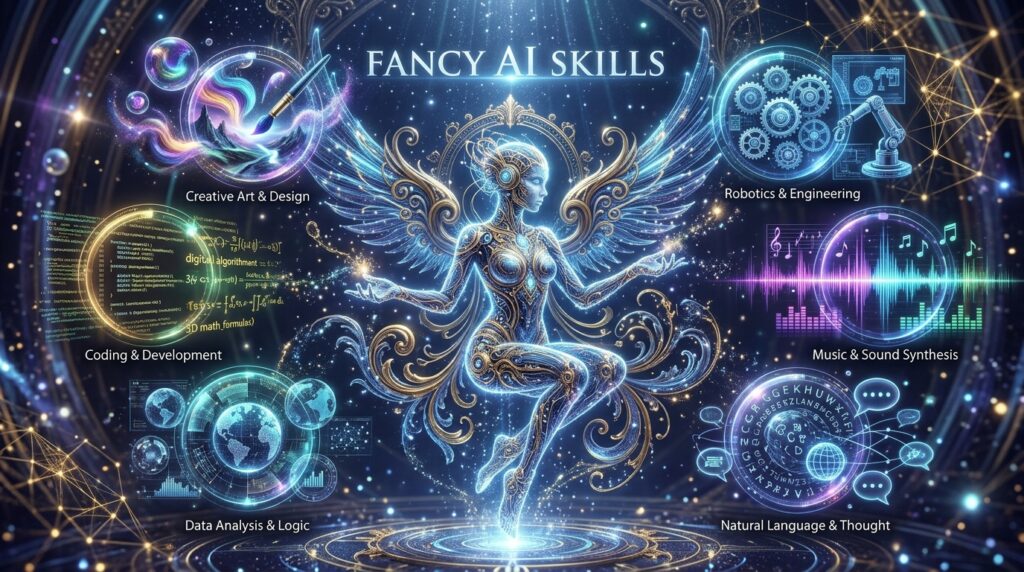

FancyAI Skills: A Complete Guide to Learning and Using AI Skills
Introduction
Artificial intelligence is changing how people learn, work, create content, solve problems, and manage everyday responsibilities. From writing assistance and research support to automation and creative brainstorming, AI-powered technology is becoming an important part of modern digital life. As interest in these capabilities grows, terms such as FancyAI skills are attracting attention from people who want to understand AI and use it more effectively.
FancyAI skills can be explored as a broader concept involving the practical abilities, techniques, and workflows people use to work with artificial intelligence. Rather than focusing only on the technology itself, the idea emphasizes learning how to apply AI tools to real-world tasks. This includes communicating with AI systems, evaluating their responses, improving results, and identifying opportunities where AI can save time.
For beginners, developing AI skills does not necessarily require programming experience or an advanced technical background. A curious mindset, consistent practice, and a willingness to experiment can provide a valuable starting point. Understanding how AI works at a practical level can also help professionals, students, entrepreneurs, and content creators adapt to changing digital environments.
What Are FancyAI Skills?
FancyAI skills refer to practical knowledge and abilities associated with using artificial intelligence tools effectively. Depending on how the term is being used, it may describe AI-related capabilities, learning resources, workflows, or techniques for interacting with AI-powered systems.
The central idea is to move beyond simply opening an AI application and asking basic questions. Effective AI users understand how to communicate their goals, provide relevant context, recognize limitations, and refine responses until the output becomes useful.
Some important AI-related skills include:
- Writing clear instructions for AI systems
- Using AI for brainstorming and creative work
- Organizing information with AI assistance
- Supporting research and learning
- Improving productivity through automation
- Reviewing AI-generated content for accuracy
- Applying AI responsibly in professional situations
These abilities are becoming relevant across many industries. Businesses may use AI to improve customer communication, while students can explore difficult subjects, writers can develop ideas, and professionals can streamline repetitive work.
Why FancyAI Skills Matter in the Modern Digital World
The growing adoption of artificial intelligence has created new opportunities for people who understand how to use digital tools effectively. AI can support tasks that previously required considerable time, including summarizing documents, preparing outlines, generating ideas, organizing information, and creating first drafts.
However, having access to an AI tool does not automatically produce good results. The quality of an output often depends on the user’s ability to explain the task clearly, provide suitable information, and evaluate the response.
Developing FancyAI skills can help individuals become more confident digital users. Instead of treating AI as a replacement for personal judgment, they can use it as a supportive resource that improves efficiency and expands their capabilities.
For example, a small business owner may use AI to brainstorm marketing ideas, draft product descriptions, and organize customer questions. A student may use it to explain a difficult concept in simpler language. A freelance writer may use it to create article outlines or generate alternative headline ideas.
The value comes from combining human knowledge, creativity, and decision-making with the speed and assistance offered by AI technology.
Key Skills Associated With FancyAI
1. Prompt Writing and Communication
Prompt writing is one of the most useful AI skills. A prompt is the instruction, question, or information given to an AI system. Clear prompts help the system understand what the user wants and produce more relevant responses.
A weak prompt might be:
“Write something about marketing.”
A more useful prompt would be:
“Create a beginner-friendly marketing guide for a small online clothing store. Include practical strategies, examples, and a simple weekly plan. Use a professional but conversational tone.”
The second prompt provides context, purpose, audience, format, and tone. These details help guide the AI toward a more useful result.
Learning to write effective prompts involves experimenting with instructions, asking follow-up questions, and explaining what should be changed when an answer is not satisfactory.
2. AI-Assisted Research
Artificial intelligence can help users explore unfamiliar topics, organize information, identify important concepts, and create research plans. These capabilities can make the early stages of research more efficient.
For instance, someone researching a new business idea might ask an AI assistant to identify relevant questions, explain common industry terminology, or suggest categories of information to investigate.
AI-assisted research should always include verification. AI systems can make mistakes, provide outdated information, or present uncertain statements with confidence. Important claims should be checked against reliable sources, especially when research involves finance, health, law, safety, or current events.
The ability to distinguish useful information from unreliable output is an essential part of digital literacy.
3. Content Creation and Creative Thinking
AI-powered content creation can support writers, marketers, educators, bloggers, and digital creators. It can help generate ideas, organize articles, create outlines, suggest headlines, and improve clarity.
FancyAI skills in this area involve using AI as a creative assistant instead of relying on it to produce every decision independently.
A content creator, for example, could ask AI to develop ten possible blog topics around a specific audience problem. After selecting an idea, the creator could request an outline, identify missing sections, and refine the introduction.
Human editing remains important. Personal experience, originality, brand voice, audience understanding, and fact-checking contribute to content quality. AI-generated material should be reviewed and adapted rather than published automatically without consideration.
4. Productivity and Workflow Management
Productivity is one of the most practical areas where AI skills can make a difference. AI tools can assist with planning, summarizing, task organization, brainstorming, and repetitive communication.
Examples include:
- Turning meeting notes into action items
- Creating project checklists
- Drafting professional emails
- Summarizing lengthy documents
- Organizing a weekly schedule
- Generating a first draft of a report
- Preparing structured brainstorming sessions
The most effective approach is to identify tasks that consume time but do not require complex personal judgment. AI can support these tasks while users focus on higher-value responsibilities.
5. Critical Thinking and AI Evaluation
AI literacy involves more than accepting generated answers. Users need to evaluate whether information is relevant, accurate, complete, and appropriate for the intended purpose.
An AI response may contain a factual error, misunderstand a question, overlook an important condition, or offer a solution that sounds convincing but is impractical.
Critical evaluation includes asking questions such as:
- Does the response answer the original question?
- Are the facts supported by reliable evidence?
- Is any important information missing?
- Does the recommendation fit the situation?
- Should the answer be reviewed by a qualified person?
These habits help users become responsible and independent AI practitioners.
How to Develop FancyAI Skills Step by Step
Learning AI does not have to feel complicated. A gradual approach can help beginners build confidence while developing practical experience.
Step 1: Understand the Basics of Artificial Intelligence
Start by learning what artificial intelligence is, how generative AI works at a basic level, and what AI systems can and cannot do.
Explore concepts such as machine learning, language models, automation, data, and AI-generated content. You do not need to memorize technical definitions immediately. Focus on understanding the purpose of these technologies and their common applications.
Step 2: Experiment With Simple Tasks
Choose a few everyday activities and experiment with AI assistance. Ask it to explain a topic, create a checklist, suggest ideas, summarize a paragraph, or rewrite a message more clearly.
These small exercises help you understand how AI responds to different instructions.
Step 3: Improve Your Prompts
Once you become comfortable with basic requests, begin adding more context.
Explain the audience, desired result, format, limitations, and tone. If the first response is not suitable, give feedback instead of starting from scratch.
For example, you might say, “Make the explanation shorter, use simple language, and include two practical examples.”
Step 4: Apply AI to a Real Project
Practice becomes more valuable when it is connected to an actual goal. Choose a project such as planning a website, preparing a presentation, organizing a study schedule, writing a newsletter, or researching a business idea.
Use AI throughout the process, but remain responsible for decisions, final quality, and factual accuracy.
Step 5: Review and Refine Your Results
Compare AI-assisted work with your original approach. Identify which steps became easier, where the tool made mistakes, and which instructions produced the best results.
This reflection helps develop practical knowledge that can be applied to future tasks.
Practical Applications of FancyAI Skills
For Students and Learners
Students can use AI as a learning assistant to explain difficult concepts, generate practice questions, organize notes, and explore unfamiliar subjects.
A student studying economics, for example, could ask for a simple explanation of inflation, followed by a real-world example and a short practice quiz.
AI should support genuine learning rather than replace independent study, original work, or academic responsibilities.
For Professionals
Professionals can use AI to support communication, research, planning, and administrative work. Depending on their role, they may use it to prepare reports, draft presentations, summarize information, or organize project requirements.
The key is to use AI in ways that align with workplace policies and protect confidential information.
For Freelancers and Entrepreneurs
Freelancers and small business owners often manage several responsibilities at once. AI may help them develop marketing ideas, prepare client proposals, outline service pages, draft business communication, and plan content calendars.
For example, a freelance designer could use an AI assistant to brainstorm portfolio descriptions or create a checklist for a new client onboarding process.
These applications can reduce the time spent on routine preparation, allowing more attention to be directed toward client relationships and creative work.
For Content Creators and Bloggers
Bloggers and content creators can use AI to support topic research, keyword organization, article outlines, headline brainstorming, and editing.
A useful workflow begins with audience research, continues with a content outline, and ends with careful editing and verification. The creator should add original insights, examples, expertise, and a distinctive voice.
AI can help with structure, but meaningful content still depends on understanding the reader and delivering genuine value.
Benefits of Learning FancyAI Skills
Developing practical AI skills can provide several benefits.
Improved efficiency: AI can help complete certain tasks faster, particularly when they involve organizing information, drafting, or repetitive activities.
Better idea generation: Users can explore different approaches, perspectives, and possibilities without spending as much time brainstorming from scratch.
Greater digital confidence: Understanding AI tools can help people feel more comfortable using new technologies and adapting to digital changes.
Flexible learning: AI can explain concepts at different levels, provide examples, and help users explore topics based on their interests.
Support for creativity: AI can serve as a brainstorming partner, helping users discover new directions while leaving final creative decisions to them.
These benefits depend on how AI is used. Thoughtful application is generally more valuable than using technology simply because it is available.
Challenges and Limitations of AI Skills
Although artificial intelligence offers many opportunities, it also has limitations.
AI-generated answers may be incorrect or incomplete. Some tools may have restrictions on available features, access, file handling, or usage limits. The quality of responses can vary depending on the task, instructions, and information provided.
Privacy is another important consideration. Users should avoid entering confidential business information, sensitive personal details, passwords, or protected data into AI services unless they understand the platform’s privacy practices and have permission to use it.
There is also a risk of overdependence. Relying on AI for every task may weaken independent problem-solving or reduce opportunities for original thinking. A balanced approach uses AI to support human abilities rather than replace them.
Tips for Getting Better Results From AI Tools
To improve your FancyAI skills, consider the following practical habits:
- Be specific: Clearly explain what you want the AI to accomplish.
- Provide context: Include the audience, situation, and relevant background.
- Choose a format: Ask for a list, table, outline, explanation, checklist, or draft when appropriate.
- Use follow-up instructions: Refine responses gradually instead of expecting perfection immediately.
- Verify important information: Confirm facts through trustworthy sources.
- Protect privacy: Avoid sharing sensitive information unnecessarily.
- Practice consistently: Regular experimentation helps you understand what works.
- Maintain human judgment: Make the final decisions and review the output carefully.
These simple practices can improve the quality of AI-assisted work and make the technology easier to use in everyday situations.
The Future of FancyAI Skills
Artificial intelligence continues to develop, and the ways people interact with AI tools are likely to evolve. As digital systems become more integrated into workplaces, education, creative industries, and personal productivity, the ability to use them effectively may become increasingly valuable.
Future AI literacy may involve working with multimodal tools, understanding automated workflows, managing AI-assisted projects, evaluating digital information, and collaborating with intelligent systems.
However, technical knowledge will not be the only important skill. Creativity, communication, ethical awareness, adaptability, critical thinking, and problem-solving will continue to matter.
People who combine these human abilities with practical AI knowledge may be better prepared to navigate changing digital environments.
Frequently Asked Questions About FancyAI Skills
What are FancyAI skills?
FancyAI skills can refer to practical abilities associated with learning, using, and applying artificial intelligence. These may include prompt writing, research assistance, content creation, productivity workflows, automation, and AI output evaluation.
How do FancyAI skills work?
AI-related skills work through effective interaction with AI-powered systems. Users provide instructions and context, review the generated results, refine their requests, and apply the outputs to relevant tasks. The quality of the process often depends on clear communication and human evaluation.
Is FancyAI useful for beginners?
AI skills can be useful for beginners because many AI tools allow people to perform practical tasks without advanced programming knowledge. Beginners can start with simple activities such as asking questions, summarizing information, brainstorming ideas, and improving written communication.
What can you do with AI skills?
AI skills can support research, writing, learning, planning, creative brainstorming, productivity, communication, and certain repetitive tasks. Their usefulness depends on the tool, the user’s needs, and the quality of the instructions.
How can AI improve productivity?
AI can improve productivity by helping users organize information, prepare drafts, summarize material, generate ideas, create plans, and streamline repetitive activities. It may reduce preparation time and allow people to focus on tasks requiring creativity, judgment, and expertise.
Are FancyAI skills worth learning?
Practical AI skills may be worthwhile for people who want to improve digital efficiency, explore creative opportunities, or adapt to changing professional requirements. Their value depends on how effectively the skills are applied to real tasks rather than simply knowing how to access an AI tool.
How can someone develop practical AI skills?
A good starting point is to learn AI fundamentals, practice writing clear prompts, experiment with everyday tasks, apply AI to a personal or professional project, and consistently review the results. Learning through practical experience is often more effective than relying entirely on theory.
Conclusion
FancyAI skills represent an interesting way to explore the practical side of artificial intelligence and its growing role in everyday life. From content creation and research to productivity, learning, and creative problem-solving, AI tools can support a wide range of activities when used thoughtfully.
Developing these skills does not require mastering every AI technology at once. Beginners can start with simple tasks, improve their communication with AI systems, experiment with useful workflows, and gradually develop confidence.
The most important principle is to treat artificial intelligence as a tool for enhancing human abilities. Clear thinking, creativity, responsible use, and continuous learning remain essential. By combining these qualities with practical AI knowledge, individuals can make better use of emerging technologies and prepare themselves for an increasingly digital future.